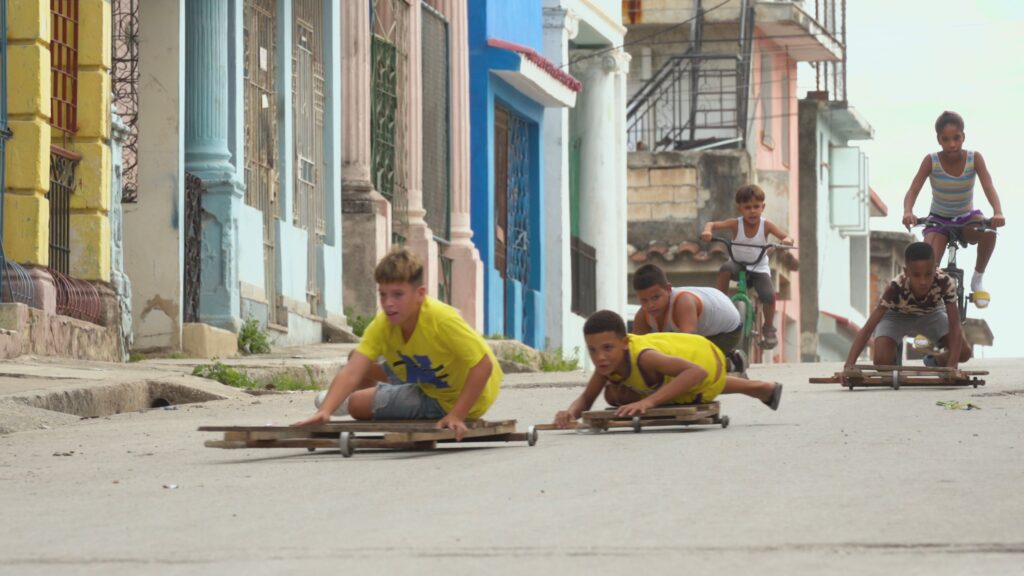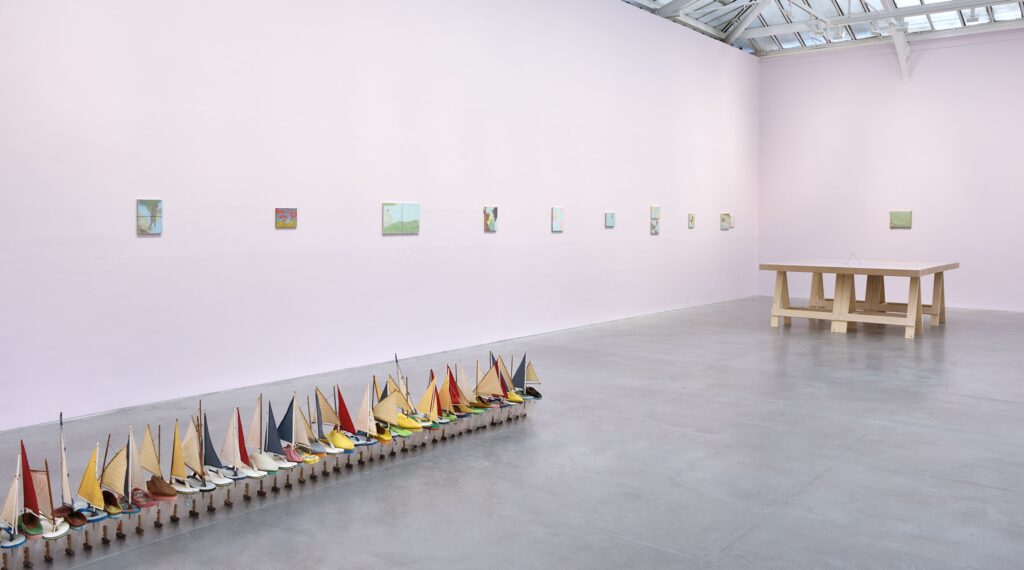
Alÿs‘ body of works encompasses many media. Whereas in the earlier years the actions were mostly performed by the artist himself, over the past decade children have become the main protagonists of his projects.These public actions are documented in video, installations, paintings, and drawings. Alÿs focusses on anthropological and geopolitical concerns centred around observations of, and engagements with, everyday life, which he has described as „a sort of discursive argument composed of episodes, metaphors, or parables.
Actions
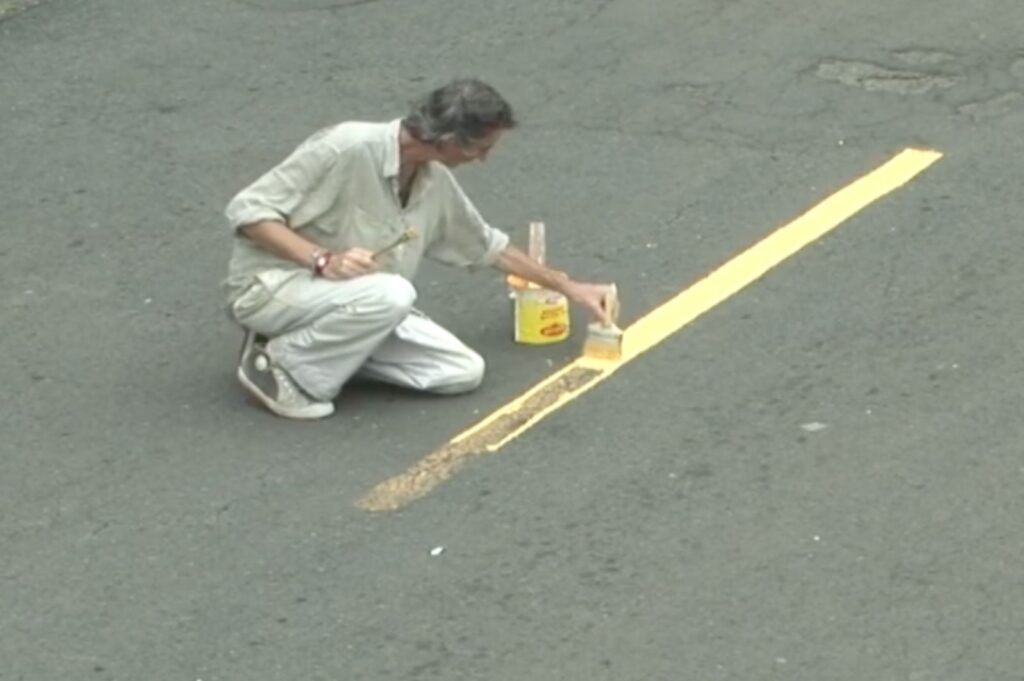
Many of his works involve observation and recording of the social, cultural and economic fabric of specific locations, commonly taking place during walks through urban areas. Citing the act of walking as the centre of his practice, for his first performance The Collector (1991), he dragged a small magnetic toy dog on wheels throughout the streets of Mexico City so as to collect any metallic residue lying in its path. In Fairy Tales (1995), he takes a walk after unravelling the sweater he has on, leaving an ever-lengthening, blue-thread trail in his wake. Also in 1995, Alÿs realized an action in São Paulo called The Leak in which he walked from a gallery, around the city, and back into the gallery trailing a dribbled line from an open can of blue paint. This action was reprised in 2004 when Alÿs traced a line of paint following the 1948 cease-fire border in Jerusalem, known as ‚the green line‘, carrying a can filled with green paint. The bottom of the can was perforated with a small hole, so the paint dripped out as a continuous squiggly line on the ground as he walked.The work Paradox of Praxis 1 (Sometimes Making Something Leads to Nothing) documents an action performed on the streets of Mexico City in 1997. The film depicts a simple and seemingly pointless endeavour, where a large block of ice is pushed through the city streets for nine hours until it melts away to a puddle of meltwater.
Rachel Spence sees Alÿs in this action as „an artist who marries surreal whimsy with ethical commitment“. The artist describes the work as a settling of accounts with minimalist sculpture. In his critique of this art form, Alÿs also chooses a simple formal language – the block of ice is a cuboid. In Paradox of Praxis 1 he addresses a spatial structure, although he does not relocate it to a gallery or to a stable public space, but to a public space that is altered and expanded until the end of the sculpture’s performance is reached. Through the act of pushing, the minimalist cuboid gradually loses its form. Not only is the ‘gallery’ in flux, the object itself is transformed. It dissolves into the urban space, which thereby becomes an element of the artistic process. The smaller the block of ice becomes, the more the space comes to the fore. Ultimately, the urban space takes the place of the sculpture, becoming the actual subject of the artwork.